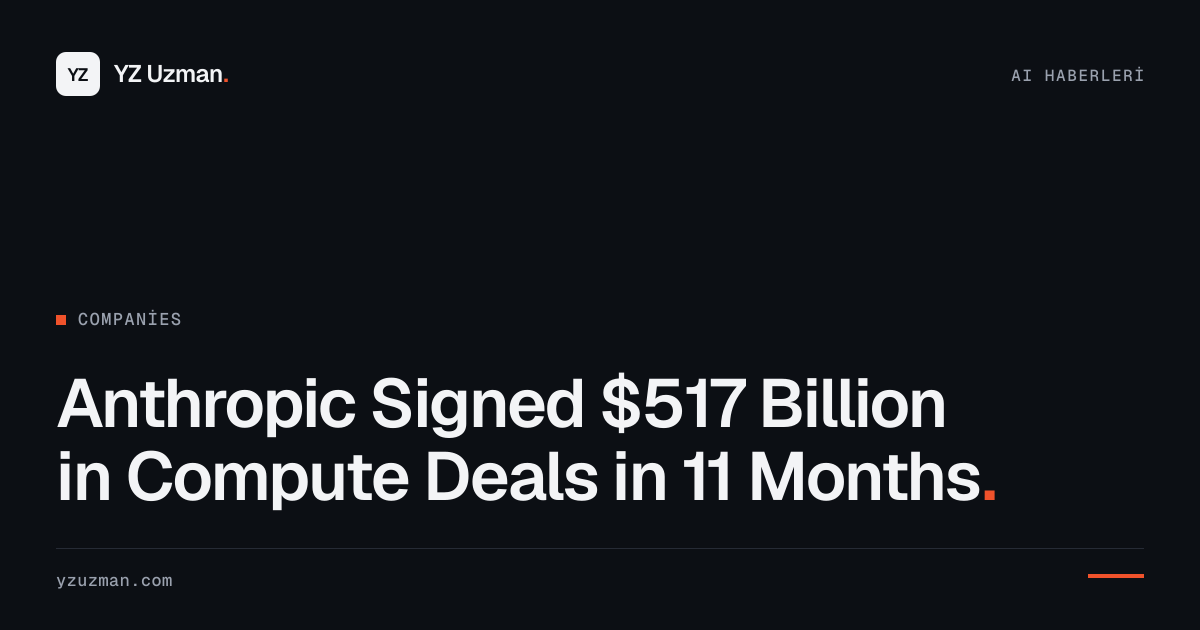
14.8 gigawatts. That is how much additional compute capacity Anthropic has put under contract since October 2025, according to a tally The Information published on September 6. The price tag attached to it: up to $517 billion in commitments over eleven months. Two days earlier, Reuters reported that the company's IPO timetable had slipped to mid-October. Read together, the two stories explain each other.
Who is supplying it, and for how much
The Information counts five groups of agreements. The largest belongs to Amazon and Google: ten-year terms, 11 gigawatts combined, and more than $300 billion in commitments. The rest breaks down as follows:
- Microsoft Azure: a 1-gigawatt lease worth about $30 billion.
- SpaceX: $45 billion through 2029, including part of the 220,000 Nvidia GPUs at the Colossus 1 site.
- Lambda and nScale: 460 megawatts over six years, roughly $80 billion.
- Fluidstack: $50 billion for purpose-built data centres housing Anthropic's Google TPUs.
For scale: before October 2025 the company had 1 to 2 gigawatts in total. Its previous guidance to investors was around $180 billion of server rental spending through 2029. The new total is close to three times that figure.
A caveat belongs here. Anthropic has not published the $517 billion number. It is The Information's own sum of disclosed deals and sourced details, and a compute commitment is a multi-year promise to buy capacity as it is built and used, paid out over years rather than today. Still, the order of magnitude is consistent with every individual deal announced so far.
The IPO moves to mid-October
Per Reuters on September 5, the prospectus had been expected to go public as early as this week; late September is now the expectation, with the roadshow possibly starting in mid-October. The company first wants to close a $15 billion revolving credit facility. Morgan Stanley, Goldman Sachs, JPMorgan and Citi are working on both the financing and the offering, and sources caution that the schedule can still move. The $2 trillion valuation investors have discussed has not changed; our August piece on the filing still applies.
Put the credit line next to the compute commitments and the delay makes sense. Against $517 billion in obligations, annualised revenue stands at $65 billion according to Bloomberg. Building a liquidity buffer and giving analysts time to absorb that ratio before pricing a listing is a reasonable choice.
How it compares with OpenAI
The Decoder's framing is worth repeating: OpenAI is targeting 30 gigawatts by 2030, with revenue above $40 billion as of July. Anthropic's 14.8 gigawatts is roughly half of that target, and on revenue the report puts it ahead of its rival. There is some irony in a half-trillion-dollar commitment list arriving a few months after Dario Amodei accused competitors of taking reckless risks. The distinction he would likely draw is that much of OpenAI's pipeline depends on sites not yet built, while most of Anthropic's is capacity inside existing cloud providers.
What changes for companies building on Claude
A commitment of this size reaches customers in three ways. Rate limits first: in May 2026, right after the SpaceX deal, Claude Code's five-hour limits were permanently doubled, and further capacity should bring similar relief. Pricing second: more supply tends to push per-token cost down, though a newly public company's margin pressure can cap how far that goes. Continuity third: ten-year infrastructure contracts are the most concrete answer available to the question of whether a supplier will still exist in two years.
Our advice is to keep the model layer swappable regardless of which provider you favour. Nobody knows where post-IPO pricing lands; changing an API key takes a day, rewriting a workflow takes months.
Sources: The Decoder, Data Center Dynamics, CNBC / Reuters