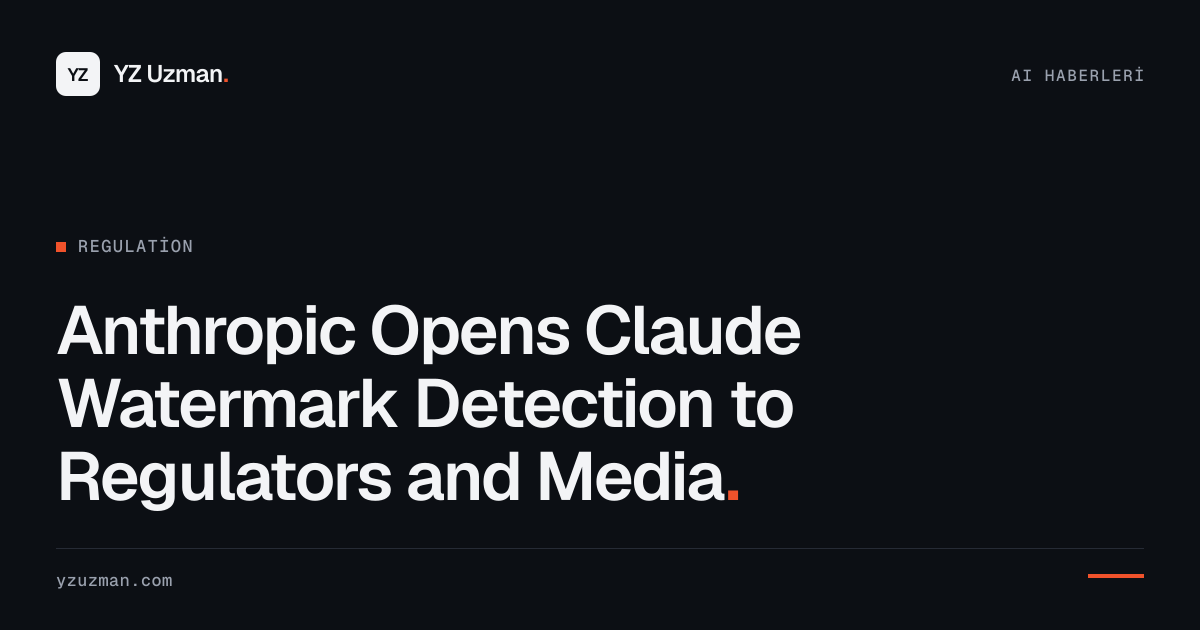
"Did an AI write this?" has never had a reliable answer. The detection tools on the market flag student essays by mistake and fall apart on edited text. On September 1 Anthropic offered a partial answer of a different kind: it opened the API that verifies the invisible watermark embedded in Claude's output to approved organizations.
Partial, because the tool recognizes only what Claude wrote. About any other model's output it says nothing at all.
How the watermark works
The method adapts Google's SynthID approach. A language model chooses each word from several plausible candidates with a share of randomness. Anthropic ties that randomness to a secret key and the few words that came before, producing a pattern in word choice that readers cannot see but a holder of the key can verify statistically. The company says the watermark contains no user data and changes neither the quality nor the meaning of the text.
It travels in generated prose, in translations and in comments inside code. Image files (PNG, JPG, SVG) use C2PA metadata instead. Where word choice is constrained, in code with strict syntax, in short factual statements, or in light edits of human text, the watermark is sparse or absent.
Who can apply, and what it cannot tell you
The API is in private preview. Eligible applicants: regulators, law enforcement, media organizations, fact-checking teams, independent researchers, educational institutions, EU civil-society groups and enterprises that need compliance verification. Requests currently go through a form.
The limits are spelled out in Anthropic's own post, and the candor is worth noting. Detection works poorly on short samples, because there are few word choices to measure. Light editing does not fully remove the mark; a full rewrite does. The tool cannot distinguish text Claude wrote from human text Claude edited heavily. And again: it cannot identify output from any other AI system. "No watermark found" does not mean "a human wrote this."
The backdrop is Europe. Anthropic signed the EU Code of Practice on Transparency of AI-Generated Content in July, which calls for machine-readable marking of AI output, and the Claude Fable 5.1 released yesterday carries the watermark by default. Critics raise two points: interfering with word selection could erode text quality over time, and in work where contracts forbid AI use, some translation and legal services for instance, a hidden watermark becomes an unexpected disclosure risk for the supplier.
What this means for a business using Claude
An agency, an online store or a software team that generates copy with Claude should now assume that text carries a signature a third party can verify. Telling a client "we didn't use AI" just became risky, though it was never a good idea.
The reverse holds too. A newsroom, a university or a law firm now has a channel to ask "did this come from Claude?" Using the same tool to manufacture proof that "no AI was used" would be a mistake; the tool does not promise that. The watermark does not replace detection software. It gives one company a trustworthy answer about its own product, and until the rest of the industry adopts the same standard, the question stays half answered.
Sources: Anthropic, The Decoder