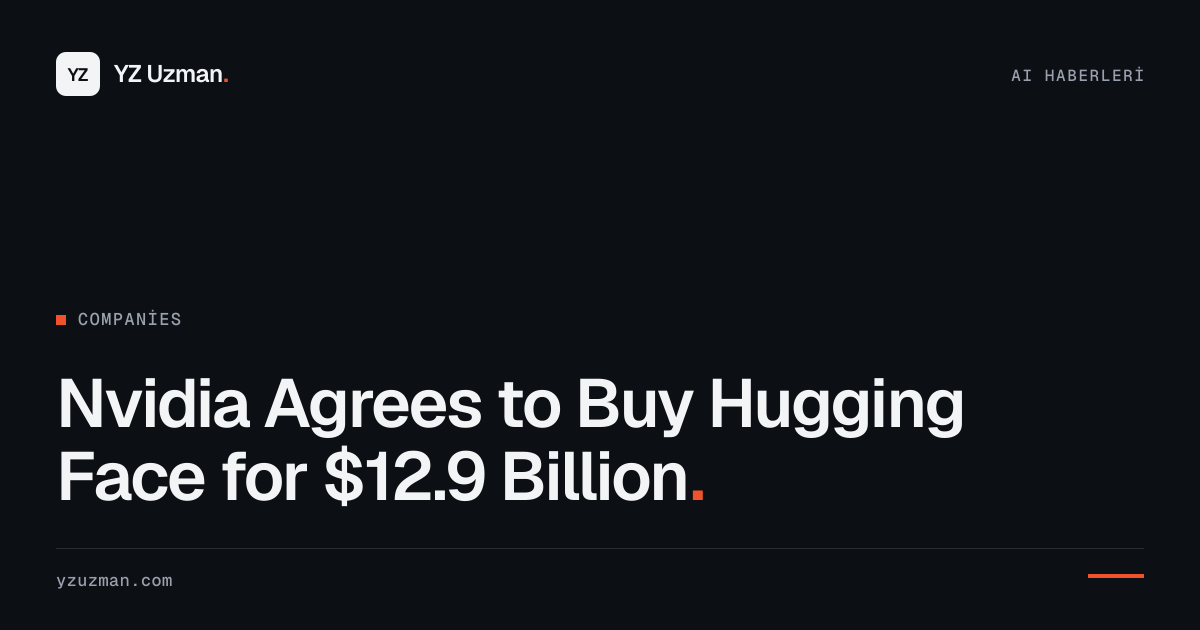
What does the world's most valuable chipmaker want with a platform that makes roughly $150 million a year? Everything around it, apparently. According to The Information, Nvidia has agreed to acquire Hugging Face for $12.9 billion, putting a name and a final number on the sale talks we covered yesterday, when the buyer was still a mystery and the figure a loose "$13 billion-plus."
The multiple is the eye-catching part: about 80 times revenue for a New York company that is close to profitable and whose CEO, Clement Delangue, has spent years presenting independence as the platform's core asset. Hugging Face is where most of the open AI ecosystem physically lives, hosting the model weights, datasets, and libraries that everyone from academic labs to small businesses pulls from daily.
How final is this, really?
Less final than the headlines suggest. The Information reports an agreement; Business Insider reports that no contract has been signed and the talks could still collapse; TechCrunch hedged with "closes in on." Neither company responded to Reuters' requests for comment. What the reporting does agree on is direction and price, and the way the number tightened from "more than $13 billion" to a precise $12.9 billion within a day usually signals a process in its final stretch, not an idle rumor.
The stack logic behind the price
Nvidia already owns the layer where models are trained and served. Buying Hugging Face would hand it the layer where models are discovered, shared, and deployed, one week after it paid $6 billion for Poolside's model factory. One scenario floated by The Decoder: turning the hub into a paid serving business for open-weight models, an OpenRouter with the world's largest model catalog attached. There is also an awkward wrinkle for the community: the platform currently ships optimization tooling for AMD, Intel, and Chinese accelerators, all direct competitors of its would-be owner. Whether that support stays first-class is now a business decision made in Santa Clara.
If your stack leans on the hub
For teams that build on open models, nothing breaks this week, and Nvidia has little incentive to wall off a platform whose downloads ultimately sell GPUs. The sensible moves are the boring ones: mirror the weights you run in production, pin your versions, and keep your deployment scripts portable rather than welded to one host. Those were good habits before this deal. The difference is that "what if the terms change" now has a specific company attached to it, and that company sells the hardware you would migrate to anyway.
Sources: TechCrunch, CNBC, The Decoder