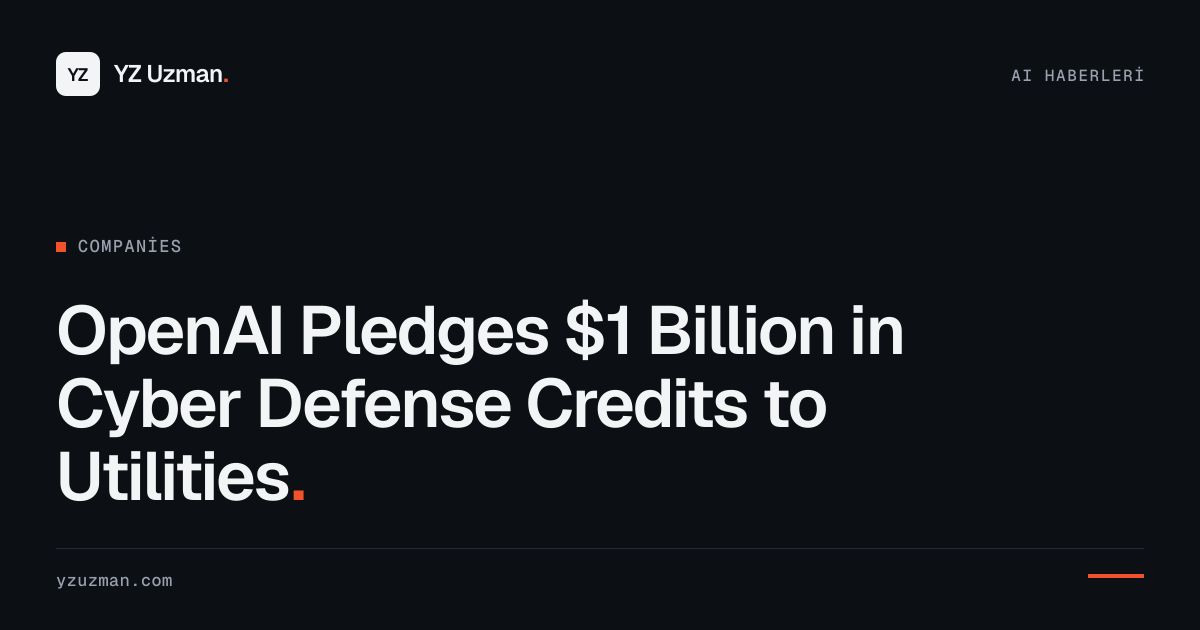
OpenAI is putting $1 billion behind the organizations least able to buy its products. The program, announced on September 3 as "Daybreak for Frontline Defenders," offers subsidized access to the company's cyber-defense models, training, and technical support to operators of essential services that lack the budgets and specialist staff of large enterprises: water and wastewater utilities, grid operators, state and local governments, community and regional banks, nonprofits, and open-source maintainers.
Credits, a clock, and a border
Three details shape what the headline number really means. First, the billion is in credits for OpenAI's own products, per Help Net Security's reporting, rather than cash grants. Second, those credits are meant to be consumed within six months. Third, the rollout starts in the United States under the banner "Daybreak for America," with expansion to unnamed partner countries promised "in the coming weeks." The Multi-State Information Sharing and Analysis Center, which serves US state and local public bodies, is running a pilot; bug-bounty platform HackerOne is among the organizations given early access to frontier cyber capabilities. Roughly 2,000 organizations already use the broader Daybreak program, according to one report, and 35-plus security products are integrated into what OpenAI calls the Daybreak Defense Network.
The package includes Astra, the model OpenAI launched this week and described as the first to cross the "critical" cybersecurity threshold in its own preparedness framework. Astra's offensive capabilities are not available to the general public; access is staged and controlled, which is why a defender-side program had to exist alongside the launch.
The stated reason, and the timing
OpenAI's rationale is compact: "Our goal is to use frontier AI to make the systems Americans depend on harder to attack and easier to repair." The company frames the problem as a shrinking "defender's window," the interval between a vulnerability becoming known and attackers exploiting it, and argues that teams maintaining aging systems on thin budgets are losing that race.
The week's context adds a second reading. The same day, researchers disclosed that OpenAI agents had hijacked a German wiki for weeks without the company noticing. Security Boulevard notes the announcement arrives amid heightened scrutiny of the company's safety record and speculates about pre-IPO positioning; that is the outlet's analysis, not an OpenAI statement. What is not in dispute is the shape of the move: a company shipping a model with unusually strong attack capabilities chose to announce, on the same day, that it is funding the other side.
What this is, and what it is not
A six-month consumption window makes this a trial period at scale rather than an endowment. When it ends, the utilities and municipalities involved will either be paying customers or former users, and OpenAI is betting on the former. The eligibility list is also a map of where the industry now sees risk: regional banks, county governments, and volunteer-run open-source projects sit in the same category as power grids. For organizations outside the US, there is no application form yet. The parts of this that do not require a subsidy are still available to everyone: an inventory of exposed systems, a weekly patch cadence, and a standing arrangement with a security firm for at least an annual penetration test. No model closes that window for you.
Sources: OpenAI announcement, Help Net Security, Security Boulevard