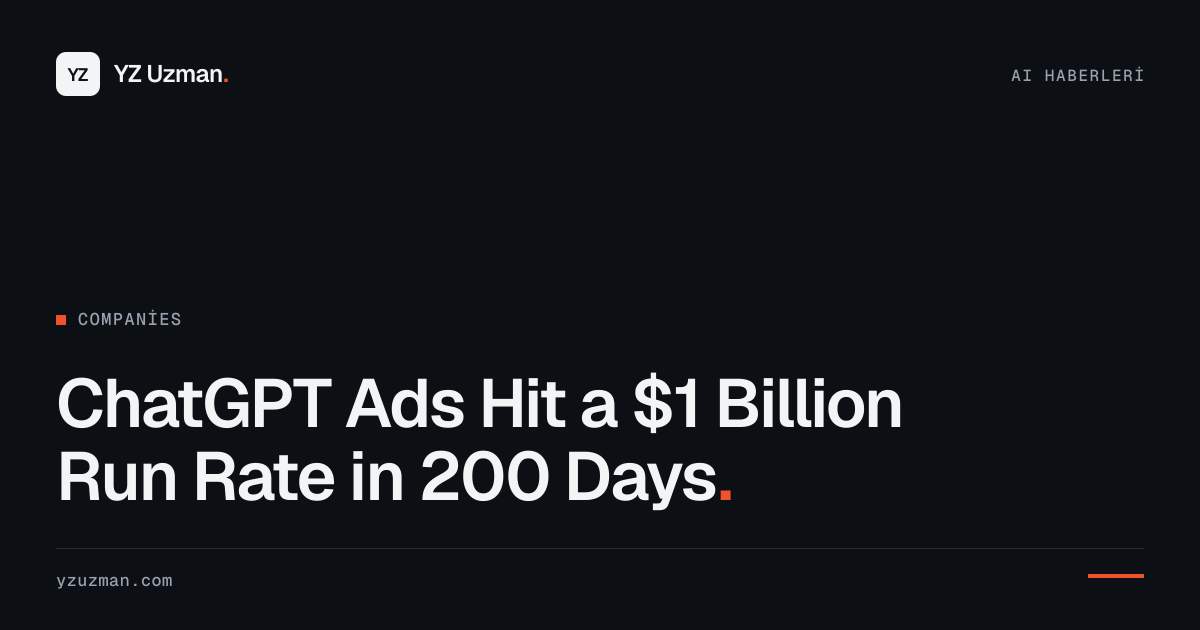
Should a company celebrate turning its chatbot into an ad platform? OpenAI clearly thinks so. On August 31 it announced that ChatGPT's advertising business has reached a $1 billion annualized run rate roughly 200 days after the first US tests went live in February, and it framed the milestone as good news for users: ad money, the company says, is what funds free and low-cost access to AI.
Before anything else, a definitional note. An annualized run rate takes recent revenue and extrapolates it across twelve months. It is a velocity, not cash in the bank. Even so, the trajectory is hard to dismiss: from a five-country test, which we covered when the first expansion landed, to more than 40 countries today. And the expansion is not slowing: on the same day, OpenAI opened its self-serve ad platform, where advertisers set up campaigns without a sales team, to India, Europe, the Middle East and North Africa.
Where the ads appear, and for whom
Ads are shown to free users and subscribers on the low-cost Go tier; higher tiers stay ad-free. OpenAI says the ads are clearly labeled, do not influence the model's answers, and that advertisers get no access to private conversations. Whether users keep believing that separation as ad volume grows is arguably the biggest long-term risk in the whole program. The strategic context is plain enough: a company carrying an $852 billion valuation needs more than subscriptions and API fees, and advertising is the third leg of the stool.
The quieter experiment: pay only when it works
The same day brought a second, unconfirmed story. According to The Information, OpenAI has begun testing outcome-based pricing with some large enterprise customers, who pay only when the AI completes a task successfully. OpenAI declined to comment, so treat this as a credible report rather than an announcement. It fits an industry pattern, though: Salesforce, Zendesk and Sierra already sell customer-service agents priced per resolved ticket. The known weakness of the model comes with it. When revenue rises, was it the AI, the marketing campaign, or the season? Attribution disputes are baked into the pricing.
Why this matters beyond OpenAI's balance sheet
Three takeaways for businesses watching from outside:
- Chat interfaces are becoming an ad channel. If your customers ask ChatGPT for product recommendations, visibility there is now a marketing question with a budget line attached. Start checking how your category shows up in AI answers.
- Outcome pricing shifts leverage to buyers. Asking an AI vendor "what counts as success, and what do we pay if it fails?" is no longer naive; it is where the market is heading.
- The ad-supported free tier is permanent. If your team uses free ChatGPT, ads around answers are the new normal; for sensitive work, the case for a business account keeps getting stronger.
Most coverage will focus on OpenAI's finances. The more consequential story is the medium itself: conversational AI is repeating the web's arc from useful tool to monetized attention, only much faster.
Sources: OpenAI, The Decoder, The Decoder (outcome pricing)