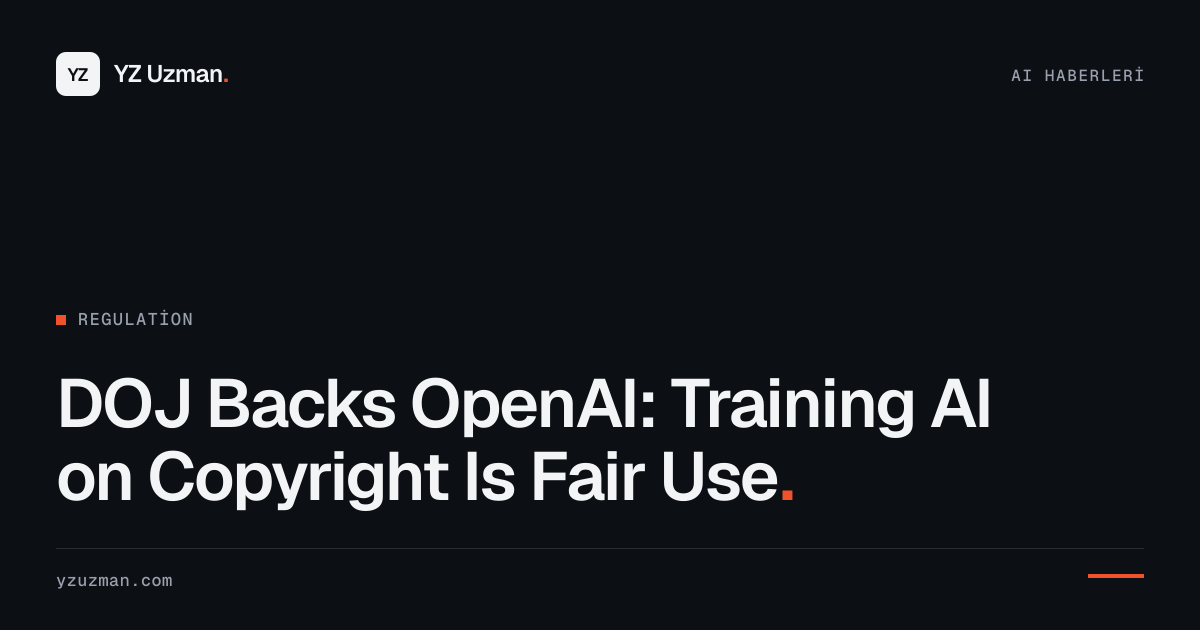
The US federal government has taken a formal side in the AI copyright fights for the first time, and it is not the publishers' side. Late on September 1 the Justice Department told the Southern District of New York that training large language models on copyrighted text qualifies as fair use.
The filing landed in The New York Times' case against OpenAI and Microsoft, before Judge Sidney Stein. The department is not a party to the suit. What it filed is a statement of interest, which carries no binding authority; Stein will still decide the fair use question on his own.
The government's argument
It rests on two legs. The first is a conventional copyright claim: training transforms the source material into something new, which is what the fair use test asks about. The department wrote that the creative possibilities and public benefits of training models this way far outweigh any competitive harm.
The second leg is less conventional. The department framed the success of the American AI industry as a matter of national security, which asks the court to weigh industrial policy alongside copyright doctrine.
The Times pushed back hard. Its spokesperson Graham James said both AI and creators can thrive, and that AI companies simply need to pay fairly for the content that makes their products possible, as copyright law requires.
The reach goes past one case
Dozens of suits from authors, publishers, record labels and news organizations turn on the same question: is training data infringement or transformative use? This is the first time the federal government has answered it on the record, and that answer will now be cited in the other dockets.
Smaller outlets are in the same fight. The Intercept has its own case running on similar ground. When one side has a budget measured in billions and the other has a legal department, the weight of a government filing is felt less in the courtroom than at the negotiating table.
Worth stating plainly, because coverage keeps blurring it: this is not a ruling. Stein has not decided anything, and he can rule against the government's position.
What it means if you own the content
If your business runs on an archive, the practical takeaway is not to wait for the verdict. The commercial effect arrives before the legal one, because a provider's willingness to license drops as its odds of winning in court rise. Licensing terms available today may be the best ones on the table for a while.
So take the technical and contractual steps now rather than after. Make your crawler rules explicit rather than implied, tag your archive so it can actually be licensed as a product, and put a training-data clause in customer and supplier contracts. None of that depends on how Stein rules.
Jurisdiction matters too. There is no flexible fair use doctrine in most of Europe; the EU instead offers a text and data mining exception with an explicit opt-out for rights holders. A publisher serving both markets is dealing with two different regimes, and a favorable US outcome does not travel.
Sources: The Washington Post, The Boston Globe, The Intercept