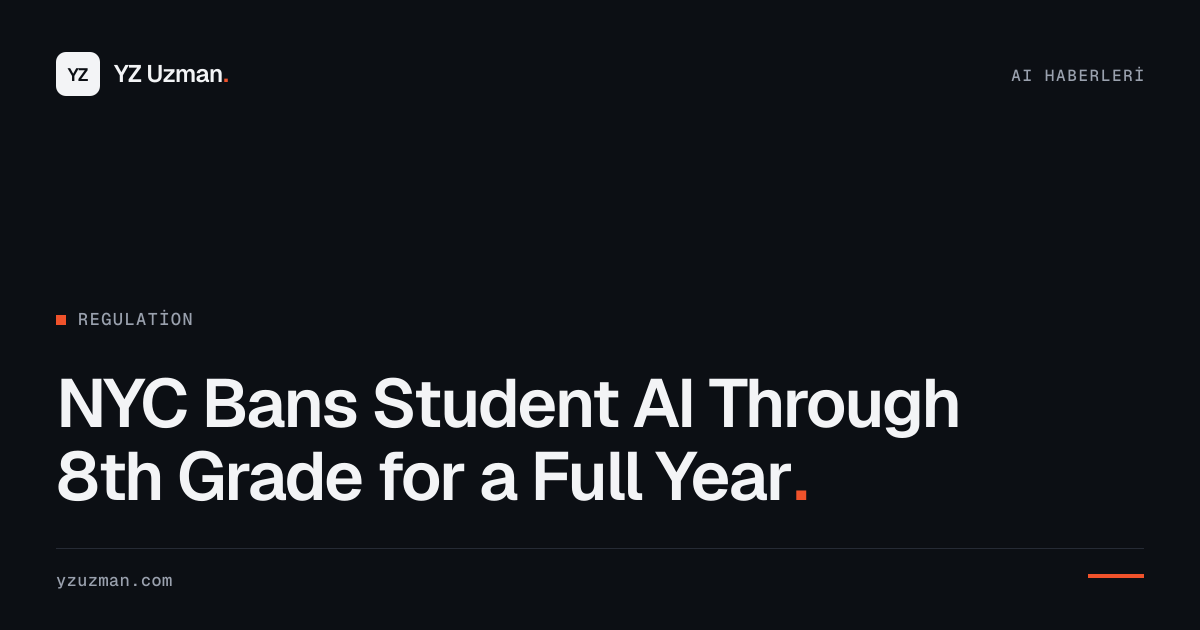
Children need teachers and human connection in order to learn and grow. That is how New York Mayor Zohran Mamdani justified the policy he announced on September 2, which halts student-facing generative AI from 2-K through eighth grade across the largest school district in the United States for one year.
The scope is roughly 600,000 students, about two thirds of total enrollment. It takes effect at the start of the 2026-2027 school year.
What is actually prohibited
There are two layers here and they are easy to conflate. The first is tied to grade level: software that puts generative AI directly in students' hands is out from 2-K through eighth grade. The second layer ignores grade level entirely. Companion chatbots are banned across all grades, high school included.
The package goes further. Time on individual devices is capped at 30 minutes a day for grades 3 to 5 and 45 minutes for grades 6 to 8. High schoolers get five limited pilot programs capped at 50,000 students, roughly 5% of enrollment, plus twice-yearly critical thinking modules running two 45-minute sessions on what AI is, how bias forms, the risks and ethics involved, and the effect on careers.
Press coverage adds a detail the announcement does not dwell on: more than 38 previously approved programs will have their AI components switched off. Chancellor Samuels framed the whole thing as putting guardrails in place to protect the human connection, curiosity and creativity that help children grow.
Is this a ban or a stalling tactic?
The policy is a moratorium, which means the real question is what happens in twelve months. The announcement does not publish any protocol for evaluating the pause when it expires. A moratorium without measurement tends to arrive at its end date with exactly the same evidence gap it started with.
Where the policy is genuinely sharper than most is the distinction it draws. A product designed to be a companion is not the same thing as a tool in a teacher's hands, and banning the first at every grade while opening limited pilots for the second shows that separation was deliberate rather than accidental.
The signal for anyone selling into schools
Plenty of education software vendors spent the past two years bolting a chat layer onto an existing product and calling it a new edition. Having the AI components of 38 approved programs disabled is precisely what happens to that kind of product when policy shifts.
The practical lesson is a procurement one. Whether your AI feature can be turned off while the rest of the product keeps working is no longer an implementation detail, it is a condition of sale. When a district changes policy, the product that degrades gracefully stays on the shelf and the one that does not gets dropped from the contract.
There is a parent-facing side too. Most public argument about AI in schools is still about cheating. The line New York drew sits somewhere else entirely: it objects to young children forming an attachment to a piece of software. That is a harder question than homework, and a more important one.
Sources: NYC Mayor's Office, CNN, The New York Times